Bulk Billed Skin Cancer Checks For Concession Card Holders – Cards accepted: Pensioner, Health Care, Senior Card, and DVA – Book Now
Introducing Excel V+ Laser Treatment, designed to treat redness, pigmentation, visible veins and more — Now Available – Book Now
Squamous Cell Carcinoma (SCC)
Squamous cell carcinoma (SCC) is the second most common form of skin cancer. It is usually less dangerous than melanoma, but unlike basal cell carcinoma it can spread to other parts of the body if it is left untreated, so early detection and treatment matter. SCC develops in the squamous cells in the upper layer of the skin, on areas most exposed to the sun.
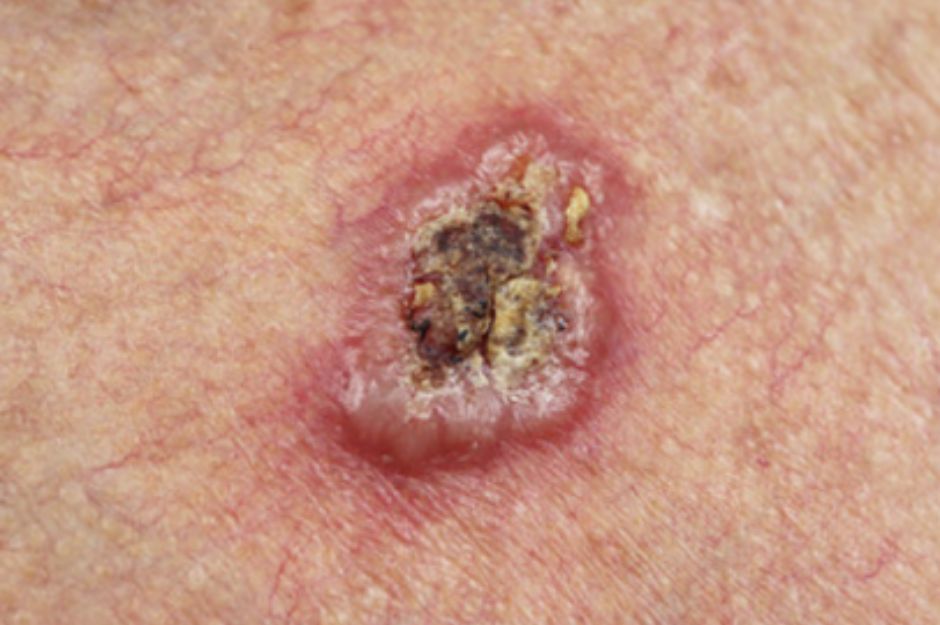
What is squamous cell carcinoma?
SCC arises in the flat squamous cells that make up most of the skin’s upper layer. With BCC it is classed as a non-melanoma or keratinocyte cancer. It usually develops over months on sun-damaged skin, and can grow more quickly than a BCC. If not treated it can spread to nearby lymph nodes and beyond, so it should be assessed and treated promptly.
What does an SCC look like?
An SCC often appears as a thickened, red, scaly spot or a firm lump. It may be tender, bleed easily, crust or ulcerate, or present as a sore that does not heal. SCCs commonly appear on the face, ears, lips, scalp, neck, backs of the hands and forearms, the areas that get the most sun.
Sunspots (actinic keratoses)
SCC can sometimes develop from sunspots (actinic keratoses), which are rough, scaly patches on sun-damaged skin. Having these checked and treated where appropriate is part of reducing your risk, and something we assess during a skin check.
Who is at risk?
Risk increases with age and lifetime sun exposure. It is higher for people with fair skin, a history of sunburn or outdoor work, previous skin cancers, many sunspots, or a weakened immune system. SCC on the lip is also linked to smoking.
How is SCC diagnosed?
Our doctors assess suspicious spots with dermoscopy and confirm the diagnosis with a biopsy (a small tissue sample examined under a microscope). Because SCC can spread, timely diagnosis is important.
How is SCC treated?
The usual treatment is surgical removal with an appropriate margin of healthy skin, from a simple excision to complex repairs with flaps or grafts. Non-surgical options may suit some early lesions. Treating SCC early greatly reduces the risk of it spreading. Our nurses provide dressings and follow-up wound care after any procedure.
Can SCC be prevented?
Sun protection is the best prevention. Cover up, use SPF30 or higher, wear a hat and sunglasses, seek shade and avoid solariums. Having sunspots checked and regular skin checks both help catch SCC early. For more information about sun protection, visit Cancer Council Australia and SunSmart.
When to see a doctor
See a doctor about any scaly or tender spot, a lump, or a sore that does not heal within a few weeks, particularly if it is growing or bleeding. No referral is needed to book a skin check with us.
Frequently Asked Questions
Is squamous cell carcinoma dangerous?
SCC is usually less dangerous than melanoma, but it can spread if left untreated. Found and treated early, it is very treatable.
What is the difference between SCC and BCC?
Both are non-melanoma skin cancers. BCC grows slowly and rarely spreads; SCC can grow faster and can spread if untreated, so it is treated promptly.
How is SCC treated?
Most SCCs are removed surgically with a margin of healthy skin. Some early lesions may suit non-surgical options. Your doctor will advise after assessment and biopsy.